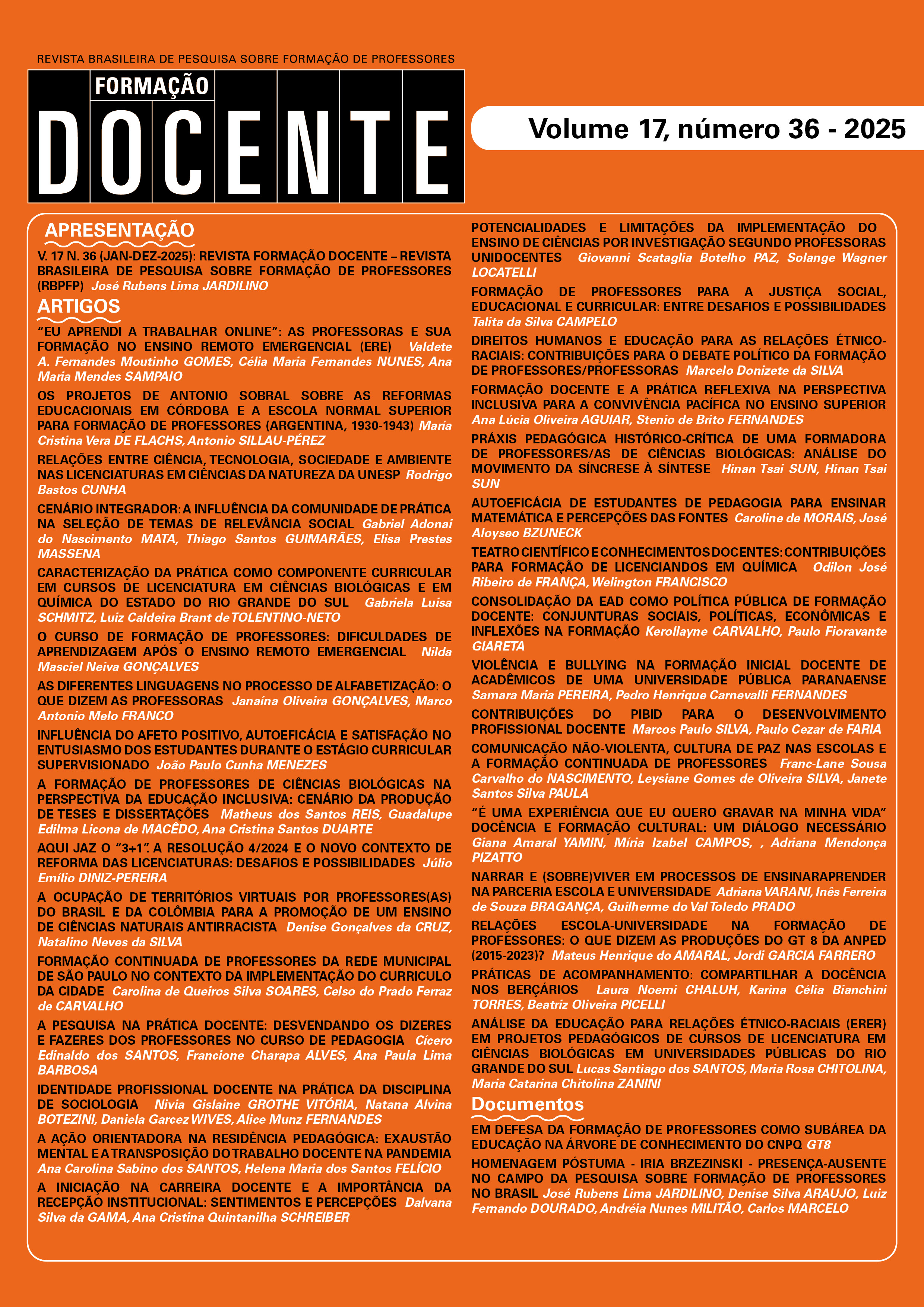
AUTOEFICÁCIA DE ESTUDANTES DE PEDAGOGIA PARA ENSINAR MATEMÁTICA E PERCEPÇÕES DAS FONTES
DOI :
https://doi.org/10.31639/rbpfp.v17.i36.e885Mots-clés :
Autoeficácia, Ensino de Matemática, Fontes de Autoeficácia, Professores em formação, Experiências no estágioRésumé
O objetivo do presente estudo foi de examinar em 513 alunos de Pedagogia a autoeficácia para ensinar matemática quando professores. Especificamente, em 97 pedagogos que haviam passado pelo estágio, buscou-se avaliar percepções das fontes dessa crença, bem como a influência de conhecimentos hauridos no curso, para se verificar em que medida se correlacionam com as crenças de autoeficácia, com valor de predição. Como resultados, a amostra total revelou escores acima da média em autoeficácia. Já entre os que haviam passado pelo estágio, essa média foi significativamente inferior em comparação com uma subamostra sem estágio. Todavia, as análises seguintes mostraram que as quatro fontes apareceram cm valor de predição positivo sobre a autoeficácia. Percepção de conhecimentos tiveram valor negativo de predição. Número de aulas no estágio fez diferença significativa nessa relação. Os resultados foram discutidos à luz da TSC e apresentadas indicações para os cursos de Pedagogia.
Téléchargements
Références
AMADOR, J. M. et al. Novice teachers’ pedagogical content knowledge for planning and implementing mathematics and science lessons. Teaching and Teacher Education, v. 115, n. 103736, p. 103736, 2022. https://doi.org/10.1016/j.tate.2022.103736 DOI: https://doi.org/10.1016/j.tate.2022.103736
BAUMANN, A. P. P.; BICUDO, Maria Ap.V. Cursos de Pedagogia e de Matemática formando professores de Matemática para os anos iniciais do Ensino Fundamental: em busca de uma compreensão. ZETETIKÉ, Campinas, v. 18, n. 34, p. 185-202, jul./dez. 2010. https://periodicos.sbu.unicamp.br/ojs/index.php/zetetike/article/view/8646683.
BANDURA, A. Human agency in social cognitive theory. American Psychologist, v. 44, n. 9, p. 1175–1184, 1989. https://doi.org/10.1037/0003-066X.44.9.1175 DOI: https://doi.org/10.1037//0003-066X.44.9.1175
BANDURA, A. Self-efficacy: the exercise of control New York: W.H. Freeman and Company, 1997.
BARDELLI, E.; RONFELDT, M.; PAPAY, J. P. Teacher Preparation Programs and Graduates’ Growth in Instructional Effectiveness. American Educational Research Journal, v. 60, n. 1, pp. 183–216, 2023. https://doi.org/10.3102/0002831222113779 DOI: https://doi.org/10.3102/00028312221137798
BERG, D. H.; SMITH, S. Teacher professional development and its impact on teachers’ self-efficacy and student achievement. Journal of Education, v. 65, n. 2, p. 98-109, 2018.
BRASIL. Lei n.º 12.014. Diário Oficial da União: Seção 1. Brasília, DF, 2009.
BRILEY, J. S. The relationships among mathematics teaching efficacy, mathematics self-efficacy, and mathematical beliefs for elementary pre-service teachers. IUMPST: The Journal, v. 5, p. 1-11, 2012.
CIRÍACO, K. T.; PIROLA, N. A. “A matemática, ela assusta um pouco”: crença de autoeficácia e mudança de atitudes de estudantes de Pedagogia a partir da pesquisa na formação inicial. Revemat Revista Eletrônica de Educação Matemática, v. 13, n. 1, p. 147–162, 2018. DOI: https://doi.org/10.5007/1981-1322.2018v13n1p147
CLARK, S.; NEWBERRY, M. Are we building preservice Teacher self-efficacy? A large-scale study examining Teacher education experiences. Asia-Pacific Journal of Teacher Education, v. 47, n. 1, p. 32–47, 2018. DOI: https://doi.org/10.1080/1359866X.2018.1497772
DEPAEPE, F.; KÖNIG, J. General pedagogical knowledge, self-efficacy and instructional practice: Disentangling their relationship in pre-service teacher education. Teaching and Teacher Education, v. 69, p. 177–190, 2018. DOI: https://doi.org/10.1016/j.tate.2017.10.003
GILES, R. M.; BYRD, K. O.; BENDOLPH, A. An investigation of elementary preservice teachers’ self-efficacy for teaching mathematics. Cogent Education, v. 3, n. 1, 1160523, 2016. DOI: https://doi.org/10.1080/2331186X.2016.1160523
GOGOL, K. M. et al. “My Questionnaire is too long!” The assessments of motivational-affective constructs with three-item and single-item measures. Contemporary Educational Psychology, v. 39, n. 3, p. 188-205, 2014. https://doi.org/10.1016/j.cedpsych.2014.04.002 DOI: https://doi.org/10.1016/j.cedpsych.2014.04.002
IAOCHITE, R. T.; SOUZA NETO, S. DE. Strength and sources of self-efficacy beliefs by physical education student teachers. Motriz: Revista de Educação Física (UNESP), v. 20, n. 2, p. 143–150, 2014. DOI: https://doi.org/10.1590/S1980-65742014000200003
IAOCHITE, R. T.; COSTA FILHO, R. A. DA. Teacher self-efficacy and its sources in physical education teaching training experiences. Journal of Physical Education, v. 31, n. 1, 2020. DOI: https://doi.org/10.4025/jphyseduc.v31i1.3123
KUHN, F. et al. Contribution of a physical education undergraduate program in the teaching self-efficacy beliefs. Journal of Physical Education, v. 31, n. 1, 2020. https://doi.org/10.4025/jphyseduc.v31i1.3147 DOI: https://doi.org/10.4025/jphyseduc.v31i1.3147
MICHAELIDES, M.P., BROWN, G.T.L., EKLÖF, H., PAPANASTASIOU, E.C. The Relationship of Motivation with Achievement in Mathematics. In: Motivational Profiles in TIMSS Mathematics. IEA Research for Education, vol 7, 2019. Cham: Springer. https://doi.org/10.1007/978-3-030-26183-2 DOI: https://doi.org/10.1007/978-3-030-26183-2_2
MIDDLETON, J.A., WIEZEL, A., JANSEN, A. et al. Tracing mathematics engagement in the first year of high school: relationships between prior experience, observed support, and task-level emotion and motivation. ZDM Mathematics Education, v. 55, p. 427–445, 2023. https://doi.org/10.1007/s11858-022-01432-9 DOI: https://doi.org/10.1007/s11858-022-01432-9
MORRIS, D. B.; USHER, E. L.; CHEN, J. A. Teacher efficacy and its impact on classroom practice. Teaching and Teacher Education, v. 55, p. 144-153, 2016.
NEWTON, K. J.; LEONARD, J.; EVANS, B. R.; EASTBURN, J. A. Preservice elementary teachers’ mathematics content knowledge and teacher efficacy. School Science & Mathematics, v. 112, p. 289–299, 2012. https://doi.org/10.1111/j.1949-8594.2012.00145.x DOI: https://doi.org/10.1111/j.1949-8594.2012.00145.x
PERERA, H. N.; JOHN, J. E. Teachers’ self-efficacy beliefs for teaching math: Relations with teacher and student outcomes. Contemporary Educational Psychology, v. 61, n. 101842, 2020.https://doi.org/10.1016/j.cedpsych.2020.101842 DOI: https://doi.org/10.1016/j.cedpsych.2020.101842
PIMENTA, S. G.; LIMA, M. S. L. Estágio e Docência. 8ª ed. São Paulo: Cortez, 2017.
SCHUNK, D. H.; DiBENEDETTO, M. K. Motivation and Social Cognitive Theory. Contemporary Educational Psychology, v. 60, january, 101832, 2020. https://doi.org/10.1016/j.cedpsych.2019.101832 DOI: https://doi.org/10.1016/j.cedpsych.2019.101832
SYMES, W.; LAZARIDES, R.; HUSSNER, I. The development of student teachers’ teacher self-efficacy before and during the COVID-19 pandemic. Teaching and Teacher Education, v. 122, 103941, 2023. DOI: https://doi.org/10.1016/j.tate.2022.103941
TOLENTINO, J. D. L.; FERREIRA, A. C.; TORISU, E. M. Autoeficácia matemática e motivação para aprender na formação inicial de pedagogos. Educação em Revista, Belo Horizonte, v. 36, e227158, 2020. DOI: https://doi.org/10.1590/0102-4698227158 DOI: https://doi.org/10.1590/0102-4698227158
TSCHANNEN-MORAN, M.; WOOLFOLK HOY, A. W. Teacher efficacy: capturing an elusive construct. Teaching and Teacher Education, v. 17, n. 7, p. 783–805, 2001. DOI: https://doi.org/10.1016/S0742-051X(01)00036-1
TÜMKAYA, G.; MÜLLER, S. The perceptions of pre and in-service teachers’ self-efficacy regarding inclusive practices: A systematised review. Ilkögretim online, p. 1061–1077, 2020. DOI: https://doi.org/10.17051/ilkonline.2020.696690
WOOLFOLK HOY, A.; BURKE SPERO, R. Changes in teacher efficacy during the early years of teaching: Acomparison of four measures. Teaching and Teacher Education, v. 21, p. 343-356, 2005. https://doi.org/10.1016/j.tate.2005.01.007 DOI: https://doi.org/10.1016/j.tate.2005.01.007
ZEE, M., KOOMEN, M. Y. Teacher self-efficacy and its effects on classroom processes, student academic achievement, and teacher well-being: A synthesis of 40 years of research. Review of Educational Research, v. 86, n. 4, 981-1015, 2016. https://doi.org/10.3102/0034654315626801 DOI: https://doi.org/10.3102/0034654315626801
Téléchargements
Publiée
Comment citer
Numéro
Rubrique
Licence
(c) Tous droits réservés Caroline de MORAIS, José Aloyseo BZUNECK (Autor) 2025

Ce travail est disponible sous licence Creative Commons Attribution - Pas d’Utilisation Commerciale - Partage dans les Mêmes Conditions 4.0 International.
Le droit d'auteur appartient exclusivement aux auteurs. Les droits de licence utilisés par le périodique sont la licence Creative Commons Attribution-NonCommercial 4.0 International (CC BY-NC-SA 4.0): Ces sont permis le partage (la copie et la distribution de matériel sous n’importe quel support ou format) et l'adaptation (remix), la transformation et la création de matériel à partir du contenu.