PEDAGOGY STUDENTS’ SELF-EFFICACY FOR MATH TEACHING AND PERCEPTIONS OF THE SOURCES
DOI:
https://doi.org/10.31639/rbpfp.v17.i36.e885Keywords:
Self-efficacy, Math teaching, Sources of Self-efficacy, Preservice teachers, TeachingpracticumAbstract
This study aimed to analyze self-efficacy beliefs for teaching math in the future in a sample of 513 Pedagogy students. Four sources contributing to the development of these beliefs during their teaching practicum include mastery experiences, vicarious experiences, verbal persuasion from teachers and physiological and affective states. Specifically, in this study, perceptions of these sources were examined to determine how well they correlate with and predict preservice teacher self-efficacy. Knowledge’s perceptions from the course were included. Results showed all four sources were strong predictors of preservice teacher self-efficacy for teaching math in the future, but knowledge’s perceptions was a negative predictor. Number of classes given in the practicum had differential effects on all variables. Implications for teacher educators are provided so as to find ways to strengthen preservice teacher self-efficacy for teaching math in their schools.
Downloads
References
AMADOR, J. M. et al. Novice teachers’ pedagogical content knowledge for planning and implementing mathematics and science lessons. Teaching and Teacher Education, v. 115, n. 103736, p. 103736, 2022. https://doi.org/10.1016/j.tate.2022.103736 DOI: https://doi.org/10.1016/j.tate.2022.103736
BAUMANN, A. P. P.; BICUDO, Maria Ap.V. Cursos de Pedagogia e de Matemática formando professores de Matemática para os anos iniciais do Ensino Fundamental: em busca de uma compreensão. ZETETIKÉ, Campinas, v. 18, n. 34, p. 185-202, jul./dez. 2010. https://periodicos.sbu.unicamp.br/ojs/index.php/zetetike/article/view/8646683.
BANDURA, A. Human agency in social cognitive theory. American Psychologist, v. 44, n. 9, p. 1175–1184, 1989. https://doi.org/10.1037/0003-066X.44.9.1175 DOI: https://doi.org/10.1037//0003-066X.44.9.1175
BANDURA, A. Self-efficacy: the exercise of control New York: W.H. Freeman and Company, 1997.
BARDELLI, E.; RONFELDT, M.; PAPAY, J. P. Teacher Preparation Programs and Graduates’ Growth in Instructional Effectiveness. American Educational Research Journal, v. 60, n. 1, pp. 183–216, 2023. https://doi.org/10.3102/0002831222113779 DOI: https://doi.org/10.3102/00028312221137798
BERG, D. H.; SMITH, S. Teacher professional development and its impact on teachers’ self-efficacy and student achievement. Journal of Education, v. 65, n. 2, p. 98-109, 2018.
BRASIL. Lei n.º 12.014. Diário Oficial da União: Seção 1. Brasília, DF, 2009.
BRILEY, J. S. The relationships among mathematics teaching efficacy, mathematics self-efficacy, and mathematical beliefs for elementary pre-service teachers. IUMPST: The Journal, v. 5, p. 1-11, 2012.
CIRÍACO, K. T.; PIROLA, N. A. “A matemática, ela assusta um pouco”: crença de autoeficácia e mudança de atitudes de estudantes de Pedagogia a partir da pesquisa na formação inicial. Revemat Revista Eletrônica de Educação Matemática, v. 13, n. 1, p. 147–162, 2018. DOI: https://doi.org/10.5007/1981-1322.2018v13n1p147
CLARK, S.; NEWBERRY, M. Are we building preservice Teacher self-efficacy? A large-scale study examining Teacher education experiences. Asia-Pacific Journal of Teacher Education, v. 47, n. 1, p. 32–47, 2018. DOI: https://doi.org/10.1080/1359866X.2018.1497772
DEPAEPE, F.; KÖNIG, J. General pedagogical knowledge, self-efficacy and instructional practice: Disentangling their relationship in pre-service teacher education. Teaching and Teacher Education, v. 69, p. 177–190, 2018. DOI: https://doi.org/10.1016/j.tate.2017.10.003
GILES, R. M.; BYRD, K. O.; BENDOLPH, A. An investigation of elementary preservice teachers’ self-efficacy for teaching mathematics. Cogent Education, v. 3, n. 1, 1160523, 2016. DOI: https://doi.org/10.1080/2331186X.2016.1160523
GOGOL, K. M. et al. “My Questionnaire is too long!” The assessments of motivational-affective constructs with three-item and single-item measures. Contemporary Educational Psychology, v. 39, n. 3, p. 188-205, 2014. https://doi.org/10.1016/j.cedpsych.2014.04.002 DOI: https://doi.org/10.1016/j.cedpsych.2014.04.002
IAOCHITE, R. T.; SOUZA NETO, S. DE. Strength and sources of self-efficacy beliefs by physical education student teachers. Motriz: Revista de Educação Física (UNESP), v. 20, n. 2, p. 143–150, 2014. DOI: https://doi.org/10.1590/S1980-65742014000200003
IAOCHITE, R. T.; COSTA FILHO, R. A. DA. Teacher self-efficacy and its sources in physical education teaching training experiences. Journal of Physical Education, v. 31, n. 1, 2020. DOI: https://doi.org/10.4025/jphyseduc.v31i1.3123
KUHN, F. et al. Contribution of a physical education undergraduate program in the teaching self-efficacy beliefs. Journal of Physical Education, v. 31, n. 1, 2020. https://doi.org/10.4025/jphyseduc.v31i1.3147 DOI: https://doi.org/10.4025/jphyseduc.v31i1.3147
MICHAELIDES, M.P., BROWN, G.T.L., EKLÖF, H., PAPANASTASIOU, E.C. The Relationship of Motivation with Achievement in Mathematics. In: Motivational Profiles in TIMSS Mathematics. IEA Research for Education, vol 7, 2019. Cham: Springer. https://doi.org/10.1007/978-3-030-26183-2 DOI: https://doi.org/10.1007/978-3-030-26183-2_2
MIDDLETON, J.A., WIEZEL, A., JANSEN, A. et al. Tracing mathematics engagement in the first year of high school: relationships between prior experience, observed support, and task-level emotion and motivation. ZDM Mathematics Education, v. 55, p. 427–445, 2023. https://doi.org/10.1007/s11858-022-01432-9 DOI: https://doi.org/10.1007/s11858-022-01432-9
MORRIS, D. B.; USHER, E. L.; CHEN, J. A. Teacher efficacy and its impact on classroom practice. Teaching and Teacher Education, v. 55, p. 144-153, 2016.
NEWTON, K. J.; LEONARD, J.; EVANS, B. R.; EASTBURN, J. A. Preservice elementary teachers’ mathematics content knowledge and teacher efficacy. School Science & Mathematics, v. 112, p. 289–299, 2012. https://doi.org/10.1111/j.1949-8594.2012.00145.x DOI: https://doi.org/10.1111/j.1949-8594.2012.00145.x
PERERA, H. N.; JOHN, J. E. Teachers’ self-efficacy beliefs for teaching math: Relations with teacher and student outcomes. Contemporary Educational Psychology, v. 61, n. 101842, 2020.https://doi.org/10.1016/j.cedpsych.2020.101842 DOI: https://doi.org/10.1016/j.cedpsych.2020.101842
PIMENTA, S. G.; LIMA, M. S. L. Estágio e Docência. 8ª ed. São Paulo: Cortez, 2017.
SCHUNK, D. H.; DiBENEDETTO, M. K. Motivation and Social Cognitive Theory. Contemporary Educational Psychology, v. 60, january, 101832, 2020. https://doi.org/10.1016/j.cedpsych.2019.101832 DOI: https://doi.org/10.1016/j.cedpsych.2019.101832
SYMES, W.; LAZARIDES, R.; HUSSNER, I. The development of student teachers’ teacher self-efficacy before and during the COVID-19 pandemic. Teaching and Teacher Education, v. 122, 103941, 2023. DOI: https://doi.org/10.1016/j.tate.2022.103941
TOLENTINO, J. D. L.; FERREIRA, A. C.; TORISU, E. M. Autoeficácia matemática e motivação para aprender na formação inicial de pedagogos. Educação em Revista, Belo Horizonte, v. 36, e227158, 2020. DOI: https://doi.org/10.1590/0102-4698227158 DOI: https://doi.org/10.1590/0102-4698227158
TSCHANNEN-MORAN, M.; WOOLFOLK HOY, A. W. Teacher efficacy: capturing an elusive construct. Teaching and Teacher Education, v. 17, n. 7, p. 783–805, 2001. DOI: https://doi.org/10.1016/S0742-051X(01)00036-1
TÜMKAYA, G.; MÜLLER, S. The perceptions of pre and in-service teachers’ self-efficacy regarding inclusive practices: A systematised review. Ilkögretim online, p. 1061–1077, 2020. DOI: https://doi.org/10.17051/ilkonline.2020.696690
WOOLFOLK HOY, A.; BURKE SPERO, R. Changes in teacher efficacy during the early years of teaching: Acomparison of four measures. Teaching and Teacher Education, v. 21, p. 343-356, 2005. https://doi.org/10.1016/j.tate.2005.01.007 DOI: https://doi.org/10.1016/j.tate.2005.01.007
ZEE, M., KOOMEN, M. Y. Teacher self-efficacy and its effects on classroom processes, student academic achievement, and teacher well-being: A synthesis of 40 years of research. Review of Educational Research, v. 86, n. 4, 981-1015, 2016. https://doi.org/10.3102/0034654315626801 DOI: https://doi.org/10.3102/0034654315626801
Downloads
Published
How to Cite
Issue
Section
License
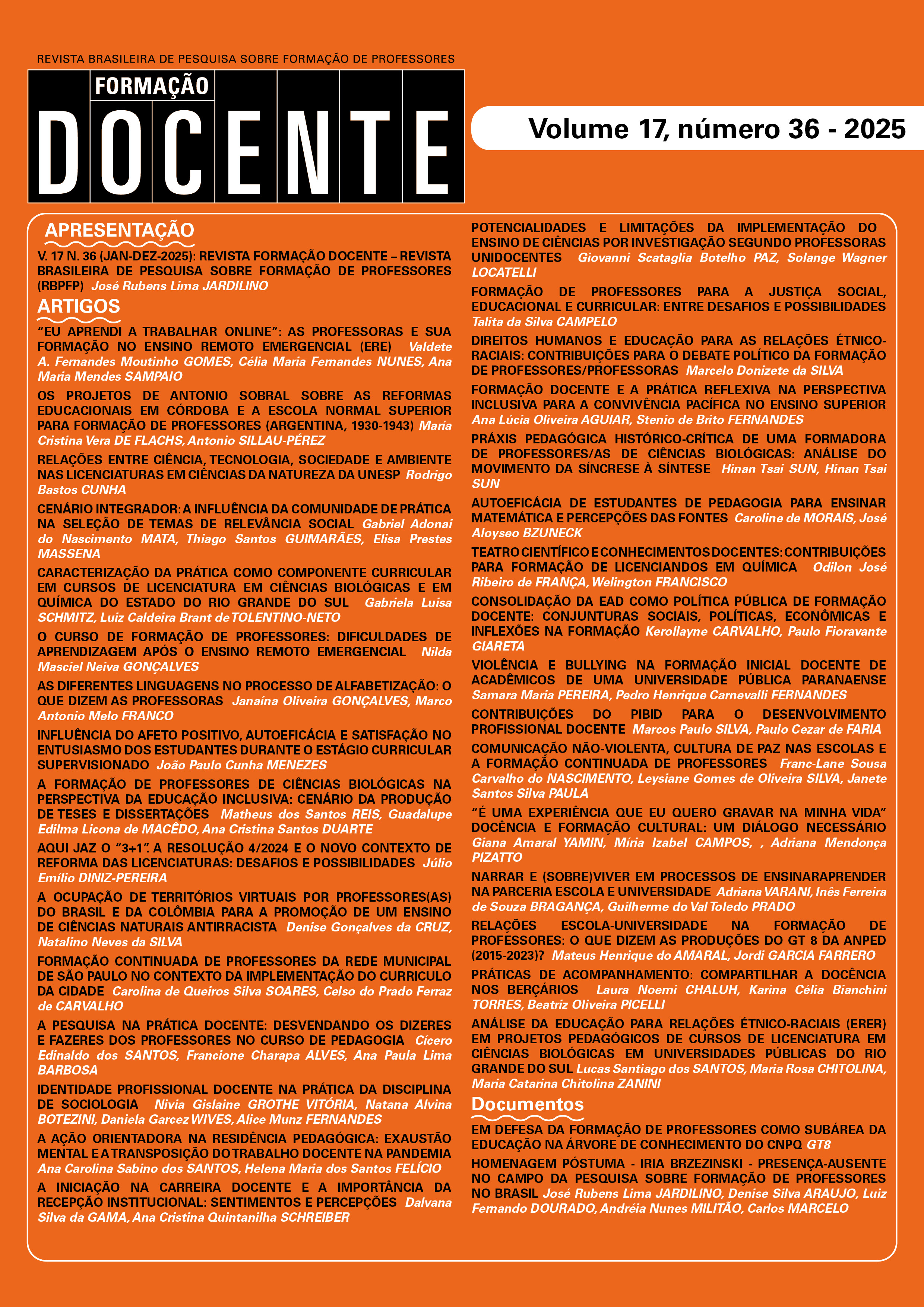
Copyright (c) 2025 Caroline de MORAIS, José Aloyseo BZUNECK (Autor)

This work is licensed under a Creative Commons Attribution-NonCommercial-ShareAlike 4.0 International License.
Copyright belongs exclusively to the authors. The license rights used by the journal are the Creative Commons Attribution-NonCommercial 4.0 International (CC BY-NC-SA 4.0) license: sharing (copying and distribution of material in any medium or format) and adaptation (remixing), transformation and creation of material from the content are allowed.